
Antenuptial contracts: Your complete guide to South African marriage contracts
Getting married in South Africa is more than a celebration of love; it’s also a legal partnership that defines how your assets, debts, and financial rights are handled during and after your marriage. Whether you’re planning a traditional wedding, civil union, or simply cohabiting as life partners, understanding how a marriage contract in South Africa works can save you financial and emotional strain later on.
This guide explains everything you need to know about South African marriage contracts, including the different types of marriages, unions, and property regimes, and how to choose the right antenuptial agreement for your circumstances.
What is an antenuptial contract?
An antenuptial contract (ANC), often called a marriage contract, is a legal agreement signed before marriage that sets out how a couple’s assets and debts will be handled during and after their union.
Without one, your marriage automatically falls “in community of property”, meaning everything you own (and owe) becomes jointly shared.
Your antenuptial contract must be drafted by a notary public and registered with the Deeds Office within three months of signing. At RSANotary.co.za, we help South Africans draft, notarise, and register these documents quickly and correctly, even if you’re overseas.
Need help with a marriage contract?
Types of marriages and unions in South Africa
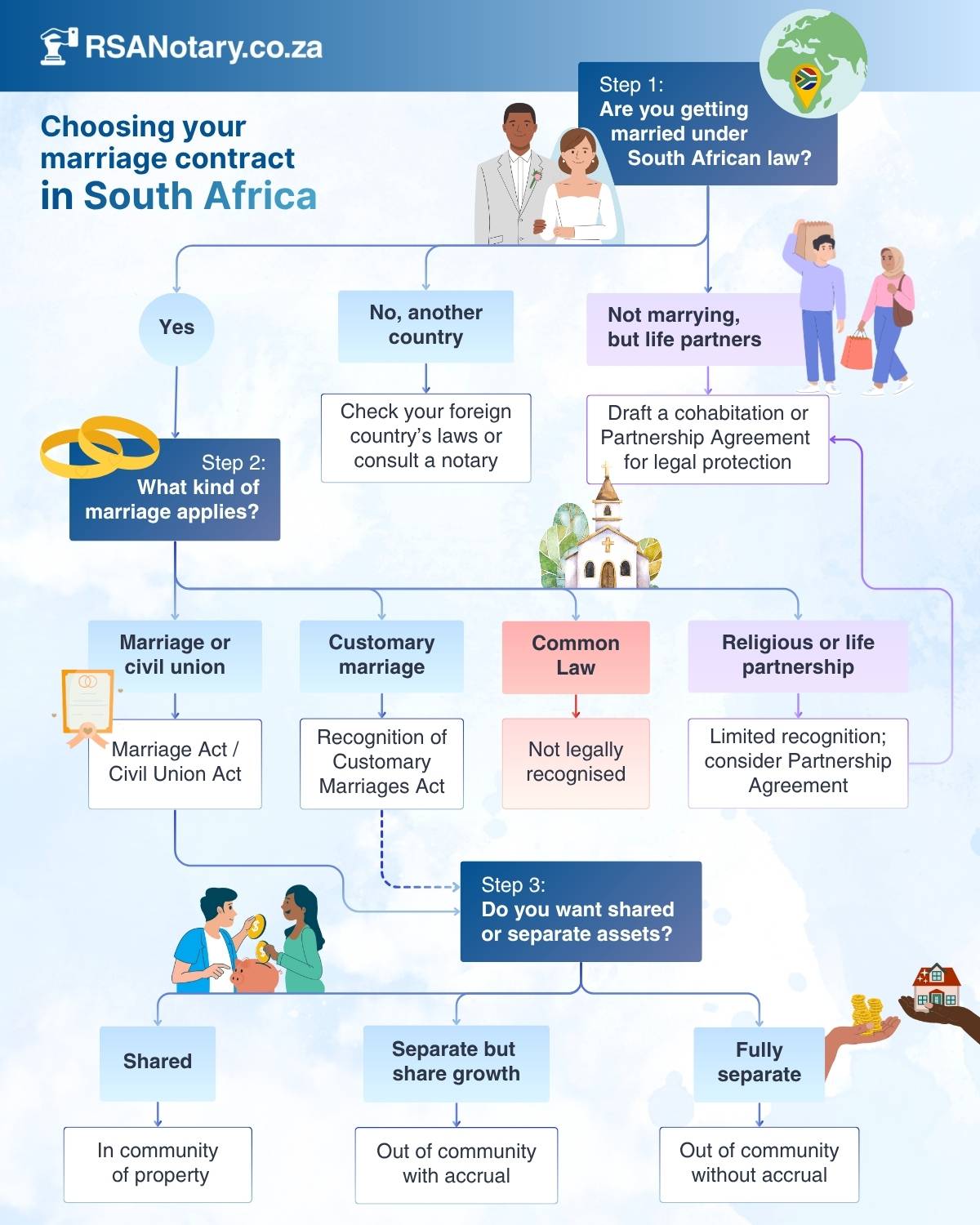
South Africa recognises several kinds of marriages and partnerships under different laws. Understanding which applies to you is the first step before deciding on your contract type.
Civil marriages
Civil marriages are governed by the Marriage Act 25 of 1961. These are the most common legal marriages performed by religious or civil marriage officers. Both opposite-sex and same-sex couples can marry under this Act (though the Civil Union Act 17 of 2006 now also provides equal recognition).
Civil unions
The Civil Union Act of 2006 allows both same-sex and opposite-sex couples to enter a legally recognised marriage or civil partnership. Couples married under this Act have the same legal status, rights, and consequences as those married under the Marriage Act.
Customary marriages
These are marriages conducted under African customary law and governed by the Recognition of Customary Marriages Act 120 of 1998. To be valid, they must follow customary traditions and be registered with Home Affairs. A customary marriage is automatically in community of property unless a valid antenuptial contract is signed before the marriage.
Religious marriages
Marriages conducted according to religious rites (such as Muslim or Hindu marriages) are not yet fully recognised under South African marriage law. However, the courts and legislature have granted piecemeal recognition in certain cases, especially regarding inheritance, maintenance, and custody.
Common law marriages
South Africa does not recognise common law marriage. Simply living together, even for many years, does not create a legal marriage. To protect your rights as a couple, you’ll need a cohabitation agreement or partnership contract.
Civil partnerships and life partnerships
For couples who choose not to marry (same-sex or opposite-sex), the law provides limited recognition through court decisions and statutes like the Domestic Partnerships Bill (pending). A civil partnership contract or cohabitation agreement is essential to set out financial and property arrangements.
South Africa’s main marriage and union laws
Here’s a quick overview of the legal framework governing marriages and partnerships:
| Law | Applies To | Key Features |
| Marriage Act 25 of 1961 | Civil marriages | Traditional legal marriages between a man and woman |
| Civil Union Act 17 of 2006 | Civil unions (same-sex or opposite-sex) | Full legal recognition equal to marriage |
| Recognition of Customary Marriages Act 120 of 1998 | Customary marriages | Automatically in community of property unless ANC signed |
| Divorce Act 70 of 1979 | All marriages | Governs divorce proceedings and dissolution of unions |
| Matrimonial Property Act 88 of 1984 | All marriages | Defines in/out of community property regimes |
| Draft Domestic Partnerships Bill | Life and civil partners | Proposed to protect cohabiting couples’ rights |
Types of marital property regimes in South Africa
When you get married, you must choose how your assets and debts will be managed. This is called your matrimonial property regime. There are three main options:
1. Marriage in community of property (no antenuptial contract)
If you don’t sign an antenuptial contract, you are automatically married in community of property.
What it means:
- All assets and debts (before and during marriage) are shared equally.
- Both partners have equal rights of ownership and responsibility for liabilities.
- If one spouse is declared insolvent, both can lose their assets.
- Upon divorce or death, the joint estate is divided 50/50.
Advantages:
- Simple, no upfront cost for a contract.
- Promotes equality and shared responsibility.
Disadvantages:
- No financial protection from a partner’s debts.
- Requires joint consent for many financial decisions.
- Not ideal for entrepreneurs or individuals with significant pre-marital assets.
2. Marriage out of community of property with accrual
If you sign an antenuptial contract with the accrual system, each spouse maintains their own estate during the marriage, but both share equally in the growth (accrual) of their estates upon divorce or death.
What it means:
- Assets before marriage remain separate.
- Assets accumulated during marriage are shared proportionally.
- Protects each spouse’s pre-marital assets and debts.
Advantages:
- Fair sharing of wealth built together.
- Protects pre-existing assets.
- Both partners benefit from financial growth.
Disadvantages:
- Requires careful valuation of assets before marriage.
- Some administrative work during dissolution.
3. Marriage out of community of property without accrual
If you want complete financial independence, you can sign an antenuptial contract excluding accrual.
What it means:
- Each spouse keeps separate ownership of all assets and debts.
- No sharing of profits, losses, or growth.
- Upon divorce or death, each party leaves with what they own.
Advantages:
- Full financial autonomy.
- Ideal for individuals with high-risk professions or existing assets.
- Simplifies business and inheritance structures.
Disadvantages:
- No shared financial growth.
- One partner may end up disadvantaged if they supported the other’s success.
Understanding the legal consequences of different marriage regimes
Your chosen property regime affects almost every part of your financial and legal life, from tax to inheritance. Here’s what you need to know before signing your South African marriage contract:
Inheritance rights
In community of property, the joint estate is treated as one. When one spouse dies, their half passes to the surviving spouse or heirs.
Out of community of property (with or without accrual) keeps estates separate, which can simplify wills and international estate planning. However, failure to update your will can cause disputes, especially in blended families.
Debt liability
In community of property marriages, you are both responsible for each other’s debts, even those you didn’t consent to.
In out of community marriages, one partner’s insolvency won’t affect the other, protecting business owners and professionals from shared risk.
Estate planning implications
Out of community systems make estate planning easier, especially for couples with international assets or trusts. You can tailor inheritance structures without needing your spouse’s consent.
Tax implications
Spouses married in community of property share income for tax purposes, meaning capital gains and investment income are divided equally.
Out of community couples are taxed separately, useful for individuals in different income brackets.
Business ownership and credit
If you’re married in community of property, you may need spousal consent to open a business, take a loan, or sign surety.
Out of community of property allows full entrepreneurial independence.
Antenuptial contract vs postnuptial contract: what’s the difference?
Most people know about antenuptial contracts, but few realise you can also sign a postnuptial contract, a legal agreement entered after marriage.
What is a postnuptial contract?
A postnuptial contract (also called a postnuptial change of matrimonial property system) lets couples alter their marital regime after marriage through a High Court application.
When is it allowed?
Under Section 21(1) of the Matrimonial Property Act 88 of 1984, spouses can apply to the High Court to change their property system if:
- Both parties consent to the change;
- Sound reasons exist for the alteration; and
- No creditors will be prejudiced.
The process
- Draft a new contract with a notary.
- Obtain affidavits explaining why the change is needed.
- Apply to the High Court for approval.
- Once approved, the new regime is registered in the Deeds Office.
When should you consider it?
- You married young and didn’t understand the implications.
- One partner starts a business or incurs professional risk.
- You or your spouse are emigrating.
- You need to restructure your estate for tax or inheritance purposes.
While postnuptial changes are possible, they’re time-consuming and costly, another reason to consult a notary before marriage.
Customary and religious marriages: What to know
Customary marriages and lobola
Under the Recognition of Customary Marriages Act, lobola negotiations alone do not make a marriage legally valid. The marriage must meet customary requirements (e.g., transfer of the bride) and be registered at Home Affairs.
Customary marriages are automatically in community of property unless an antenuptial contract is signed before the ceremony.
Muslim marriages
Until recently, Muslim marriages weren’t recognised under South African law. However, the Constitutional Court’s 2022 decision in Women’s Legal Centre Trust v President of South Africa ordered government to enact legislation protecting Muslim spouses. In the meantime, courts grant limited recognition for inheritance and divorce matters.
Hindu and Jewish marriages
These are partially recognised, mainly in maintenance and custody disputes. Couples are encouraged to register a civil marriage in addition to their religious ceremony to gain full protection.
Registering a parallel civil marriage
Religious couples can have both ceremonies: one under their faith and one registered under the Marriage Act or Civil Union Act. This ensures their marriage contract is legally enforceable in South African law.
Marriage contracts for South Africans living abroad
Many South Africans marry or reside overseas, and need their marriage contracts to be recognised internationally.
Drafting and signing remotely
You can sign your antenuptial contract abroad with assistance from a South African notary and have it authenticated through the Apostille Convention or by a South African embassy or consulate.
Apostilling and legalisation
If you’re marrying abroad, your South African ANC must often be apostilled or legalised for use in that country. RSANotary.co.za handles this entire process, from drafting to registration to apostille.
Recognition abroad
Countries like the UK, Netherlands, Australia, and Canada generally recognise South African marriage contracts, but local application can vary. Always confirm how foreign matrimonial property laws apply, especially if one spouse is a foreign national.
Domicile and jurisdiction
Your domicile (permanent legal home) can determine which law governs your marital property. Couples living overseas should clearly state in their ANC that South African law applies, to avoid confusion later.
Comparison table: property regimes at a glance
| Feature | In Community of Property | Out of COP (With Accrual) | Out of COP (Without Accrual) |
| Separate estates | ❌ | ✅ | ✅ |
| Shared debts | ✅ | ❌ | ❌ |
| Share in growth | ✅ | ✅ | ❌ |
| Financial independence | ❌ | ✅ | ✅ |
| Antenuptial contract required | ❌ | ✅ | ✅ |
| Risk protection | ❌ | ✅ | ✅ |
The process: How to register an antenuptial contract
- Consult a notary public – Only a registered notary can draft and authenticate antenuptial contracts in South Africa.
- Agree on your property regime – Decide whether you want accrual, no accrual, or to stay in community of property.
- Sign before marriage – The ANC must be signed before the marriage ceremony.
- Registration at the Deeds Office – The notary must lodge the contract within three months of signing.
- Keep a certified copy – It serves as proof of your chosen regime for legal and financial purposes.
RSANotary.co.za offers a fast and reliable antenuptial contract registration service, ideal for couples in South Africa or abroad who need official documentation handled efficiently.
Life partnerships and cohabitation agreements
If you’re not getting married but live together as partners, you’re not protected by marriage laws. South African courts have, however, extended certain rights to long-term partners in cases like inheritance and maintenance.
To protect your interests, you can sign a cohabitation agreement, which can cover:
- Property ownership and division
- Financial contributions
- Inheritance rights
- Maintenance and support arrangements
- Child custody agreements
These are particularly important for same-sex and opposite-sex couples who prefer not to legally marry.
Common misconceptions about marriage contracts in South Africa
Let’s clear up some common myths:
❌ “We’ve lived together for 10 years, so we’re automatically married.”
Not true. South Africa does not recognise common-law marriage. You must register a civil, civil union, or customary marriage.
❌ “If I die, my partner will automatically inherit my estate.”
Not unless you’re legally married or have a valid will or cohabitation agreement.
❌ “An antenuptial contract is only for the rich.”
Wrong, it’s for anyone who values clarity, fairness, and protection, regardless of income.
❌ “Out of community of property means I don’t share anything.”
You can still share in the growth of your estates under the accrual system, without sharing debts.
Practical scenarios: Choosing the right contract
Scenario 1: The entrepreneur couple
Sipho owns a construction business, while Lindi is a teacher. They choose out of community of property with accrual to protect Sipho’s business from liability while still sharing wealth accumulated during marriage.
Scenario 2: Family wealth and inheritance
A couple with inherited family farms opts for out of community of property without accrual to preserve family assets for future generations.
Scenario 3: Young professionals starting out
Thabo and Mia are just beginning their careers. They choose with accrual so they can grow together and fairly share assets built during marriage.
Scenario 4: Remarriage and blended families
An older couple, both with children from previous marriages, select without accrual for inheritance clarity and independence.
Frequently asked questions
Do you need a lawyer to draft an antenuptial contract in South Africa?
You need a notary public, a special type of attorney authorised to draft and register ANCs.
Can I change my marriage contract later?
Yes, but only through a High Court postnuptial application (Section 21 of the Matrimonial Property Act).
How long does registration take?
Once signed, your notary has three months to register your contract at the Deeds Office. RSANotary ensures fast, compliant registration.
What if we forgot to register our contract within three months?
You can apply to the High Court for condonation, but it’s costly. Always ensure timely registration.
Is an antenuptial contract valid if signed overseas?
Yes, if it’s properly notarised, authenticated, and registered with the South African Deeds Office.
Why your marriage contract matters
Your marriage contract defines not only how you share your financial lives but also how you separate them, if things ever go wrong. A well-drafted antenuptial contract protects both spouses, prevents disputes, and ensures clarity in inheritance, divorce, and business matters.
Without a contract, you could:
- Lose personal assets to your partner’s creditors
- Face complex divorce settlements
- Struggle to manage business ownership or inheritance rights
How RSANotary.co.za can help
At RSANotary.co.za, we help South Africans at home and abroad prepare, notarise, and register their marriage and partnership contracts, quickly, securely, and with full legal compliance.
Our services include:
- Drafting antenuptial contracts (with or without accrual)
- Cohabitation and civil partnership agreements
- Customary marriage registrations
- Certified translations and apostilles for use abroad
Whether you’re getting married in South Africa or planning your union overseas, our document concierge service ensures every legal formality is handled seamlessly.
Final thoughts
Marriage is one of life’s biggest commitments, emotionally, spiritually, and financially. Taking the time to understand your options under South African law will help you start your partnership on a strong, secure foundation.
If you’re planning your wedding or civil union, speak to a notary early to decide on your South African marriage contract type. With the right advice and documentation, you can focus on your future, not your paperwork.
Need help with a marriage contract?
Contact Us
Send Us a Message
"*" indicates required fields